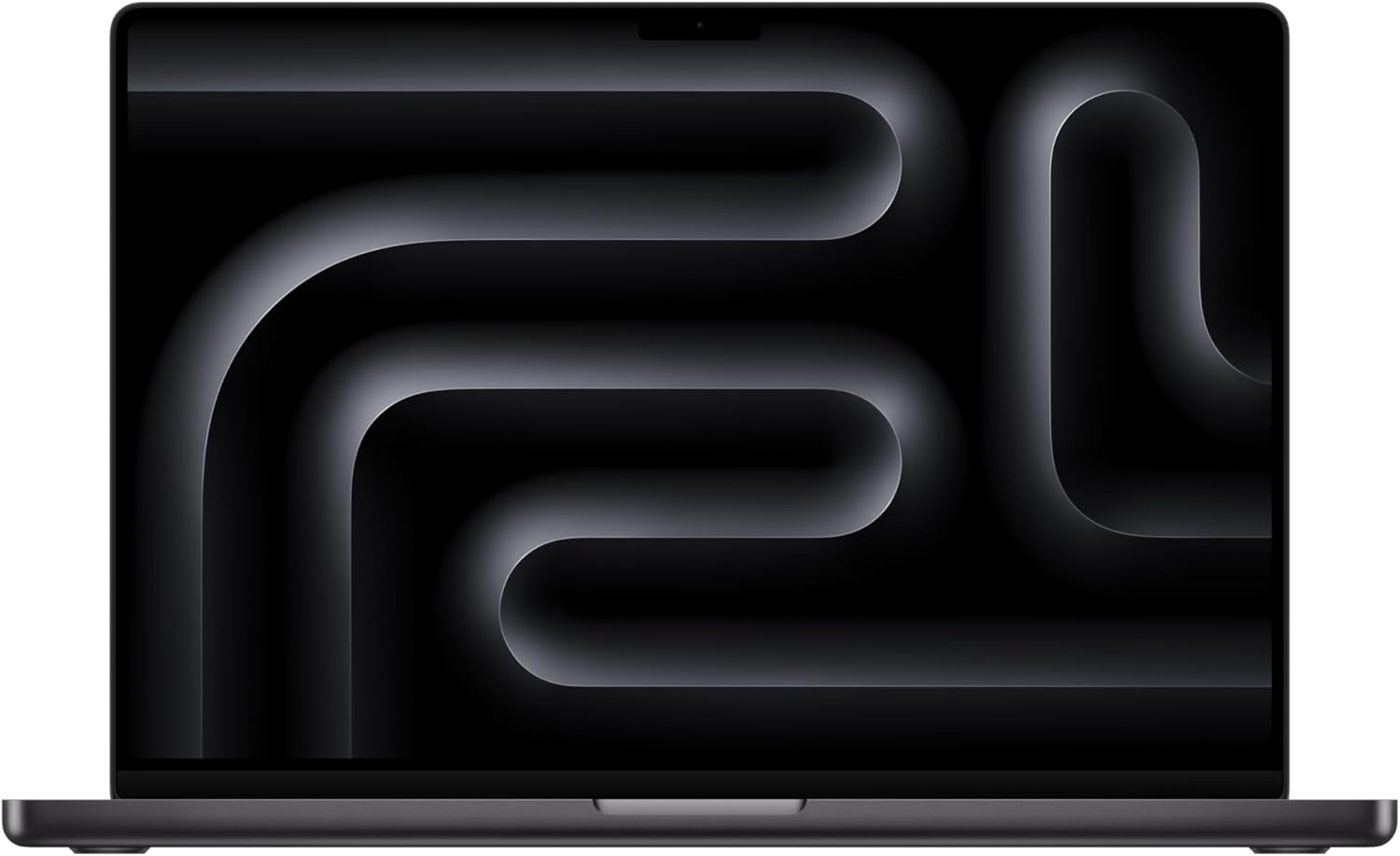
Apple 2024 MacBook Pro Laptop with M4 Pro, 14‑core CPU, 20‑core GPU: Built for Apple Intelligence, 16.2-inch Liquid Retina XDR Display, 24GB Unified Memory, 512GB SSD Storage; Space Black
Silicon Architecture Deep-Dive
The Apex of Mobile Silicon.
MacBook Pro M4 Pro.
An exhaustive engineering analysis of Apple’s 16.2-inch computational monolith. We dissect the 14-core M4 Pro architecture, the integration of Apple Intelligence, and the unprecedented thermal efficiency of the Space Black chassis.

Redefining the Parameters of Portable Computing.
For decades, the mobile workstation market was dictated by a rigid physical compromise: to achieve desktop-class computational power, one had to accept massive chassis dimensions, deafening fan acoustics, and battery lifespans measured in mere minutes when detached from the wall. The traditional x86 architecture fundamentally required vast amounts of electrical wattage to perform high-level tasks. Apple shattered this paradigm with the introduction of Apple Silicon, and with the M4 Pro, they have pushed the boundaries of performance-per-watt to extreme new limits.
The 2024 MacBook Pro 16-inch is not merely an iterative update; it is a structural reimagining of how hardware and software communicate. Encased in a breathtaking Space Black anodized aluminum chassis—specifically engineered with a proprietary chemical seal to reject fingerprints and smudges—this machine leverages a 14-core CPU and a 20-core GPU. The objective is profound: to deliver unthrottled, studio-grade performance for compiling code, rendering 3D environments, and processing machine learning algorithms, whether plugged in or operating entirely on battery power.
Silicon Engine
Apple M4 Pro (14-Core)
Graphics Logic
20-Core Hardware GPU
Memory Topology
24GB Unified Memory
Visual Output
16.2″ Liquid Retina XDR
01. The Computational Mastermind
M4 Pro Architecture & Unified Memory Topology
To truly comprehend the capabilities of this workstation, one must examine the intricate microscopic topography of the M4 Pro chip. Built on an industry-leading, second-generation 3-nanometer process technology, Apple has managed to pack billions of transistors into a surface area smaller than a postage stamp. This microscopic proximity is the secret to its speed. The 14-core CPU is divided into high-performance cores and high-efficiency cores. During standard tasks—such as web browsing or document editing—the efficiency cores take over, utilizing microscopic amounts of electricity. However, when compiling millions of lines of code in Xcode or exporting a massive logic-heavy project, the performance cores ignite, delivering desktop-class processing power instantaneously.
Perhaps the most revolutionary aspect of Apple Silicon is the Unified Memory Architecture (UMA). Traditional PC laptops separate system memory (RAM) from graphical memory (VRAM), forcing data to be copied back and forth across a PCIe bus—a process that introduces significant latency. The M4 Pro fundamentally eliminates this bottleneck. The 24GB of high-bandwidth memory sits in a single pool, accessible by the CPU, GPU, and Neural Engine simultaneously. This means massive 3D models, complex high-resolution video timelines, and large language models (LLMs) can be accessed by the graphics cores instantly without the data-copying penalty. The real-world impact is a staggering reduction in render times and an interface that feels impossibly fluid, regardless of the active payload.
Furthermore, the M4 Pro is distinctly engineered for the age of artificial intelligence. It features a dramatically enhanced Neural Engine designed explicitly for Apple Intelligence. This on-device processing system allows for complex generative tasks—such as context-aware writing assistance, advanced image generation, and intelligent workflow automation—to occur locally on the silicon rather than relying on cloud servers. This ensures unprecedented speed and, more importantly, absolute data privacy. Your proprietary data never leaves the chassis.
02. Photonic Output
The Liquid Retina XDR Display.
16.2 inches of extreme dynamic range, calibrated for cinema-grade color accuracy and 1600-nit peak brightness.
A professional-grade processing engine requires a canvas capable of displaying its output with absolute microscopic accuracy. The 16.2-inch Liquid Retina XDR display is, without hyperbole, the most advanced panel ever integrated into a mobile computer. The underlying technology relies on thousands of mini-LEDs grouped into precisely controlled local dimming zones. Unlike standard LED screens where backlights bleed across the entire panel, these local dimming zones can completely shut off, producing “true black” levels identical to OLED technology, achieving a staggering 1,000,000:1 contrast ratio.
For the professional colorist, photographer, or video editor, the display’s luminosity metrics are transformative. It sustains 1000 nits of full-screen brightness and can peak at an astonishing 1600 nits for HDR (High Dynamic Range) content. This means you can accurately grade HDR video footage directly on the laptop monitor without requiring a secondary, $5,000 reference monitor. Sunlight visibility is unparalleled; working outdoors or in brightly lit studios no longer results in screen glare obscuring your timeline.
Complementing the illumination is ProMotion technology, which dynamically adjusts the refresh rate up to 120Hz based on the on-screen content. When scrolling through heavy documentation or scrubbing a timeline, the interface glides with buttery smoothness. Conversely, when viewing static images, the refresh rate drops significantly to conserve battery life. It is a highly intelligent hardware synergy that maximizes both user experience and electrical efficiency.


Architectural Matrix & Specifications
| System Architecture | Integrated Hardware Specification | Real-World Professional Impact |
|---|---|---|
| Silicon Processing | Apple M4 Pro (14-Core CPU, 20-Core GPU) | Flawless compiling of massive codebases; instantaneous 3D rendering. |
| Memory Topology | 24GB High-Bandwidth Unified Memory | Zero-latency data sharing between CPU/GPU for seamless heavy multitasking. |
| Photonic Display | 16.2″ Liquid Retina XDR (ProMotion 120Hz) | Studio-grade HDR color grading directly on the laptop; true black contrast. |
| Machine Learning | Advanced Neural Engine (Apple Intelligence) | On-device, ultra-secure processing for AI-assisted writing and workflow generation. |
03. Thermodynamics
The Silent Thermal Envelope
High performance historically meant dealing with the acoustic nightmare of high-RPM fans trying to exhaust massive amounts of heat. The M4 Pro rewrites the rules of thermodynamics. Because the Apple Silicon architecture is incredibly power-efficient, the chip generates a fraction of the thermal density of traditional x86 processors.
Apple has integrated an advanced dual-fan thermal system into the 16-inch chassis, yet for 90% of daily professional tasks, these fans remain completely dormant. They simply do not turn on. Only under the most extreme, sustained computing limits—such as exporting a multi-hour 8K video timeline—do the fans spin up, and even then, the acoustic profile is a barely perceptible whisper. This ensures a distraction-free, highly focused professional environment, crucial for audio engineers, producers, and writers.
04. The Economics of Hardware
Longevity & macOS Synergy
When evaluating a capital hardware purchase, the focus must shift from the initial retail price to the “cost-per-year” over the machine’s lifespan. The MacBook Pro is an undisputed champion of longevity. Thanks to the extreme efficiency of the M4 Pro, battery degradation is dramatically reduced. The laptop delivers up to 22 hours of battery life, meaning fewer charging cycles, less thermal stress on the lithium-ion cells, and a battery that remains healthy for years.
Furthermore, the hardware is inextricably bound to macOS and the broader Apple Ecosystem. Features like iPhone Mirroring allow you to view and interact with your mobile device directly on the Mac display without picking up the phone. Universal Clipboard lets you copy text on an iPad and paste it on the Mac instantly. This frictionless ecosystem eliminates micro-delays in your workflow. Sourcing the MacBook Pro M4 is not an expense; it is a long-term investment in a computing asset that retains extraordinary resale value and guarantees years of uninterrupted, studio-grade productivity.

THE FINAL VERDICT
The Pinnacle of Professional Computing
Engineering Highlights
-
✦
The M4 Pro delivers outrageous, unthrottled performance whether plugged in or on battery power. -
✦
24GB of Unified Memory completely eliminates standard PCIe data transfer bottlenecks. -
✦
The 16.2″ Liquid Retina XDR screen provides 1600-nit peak brightness for flawless HDR grading. -
✦
Space Black anodization chemistry utilizes a breakthrough seal to severely reduce fingerprints.
Why It’s a Smart Investment
-
✦
Unmatched battery efficiency guarantees all-day productivity without hunting for wall outlets. -
✦
Built from the ground up for absolute on-device privacy via Apple Intelligence. -
✦
Frictionless integration with iPhone, iPad, and AirPods drastically accelerates daily workflows. -
✦
Apple computers historically retain massive resale value compared to x86 Windows alternatives.
Upgrade Your Digital Workstation
Check Authenticated Availability on Amazon
As an Amazon Associate I earn from qualifying purchases. Prices and availability are subject to change.